
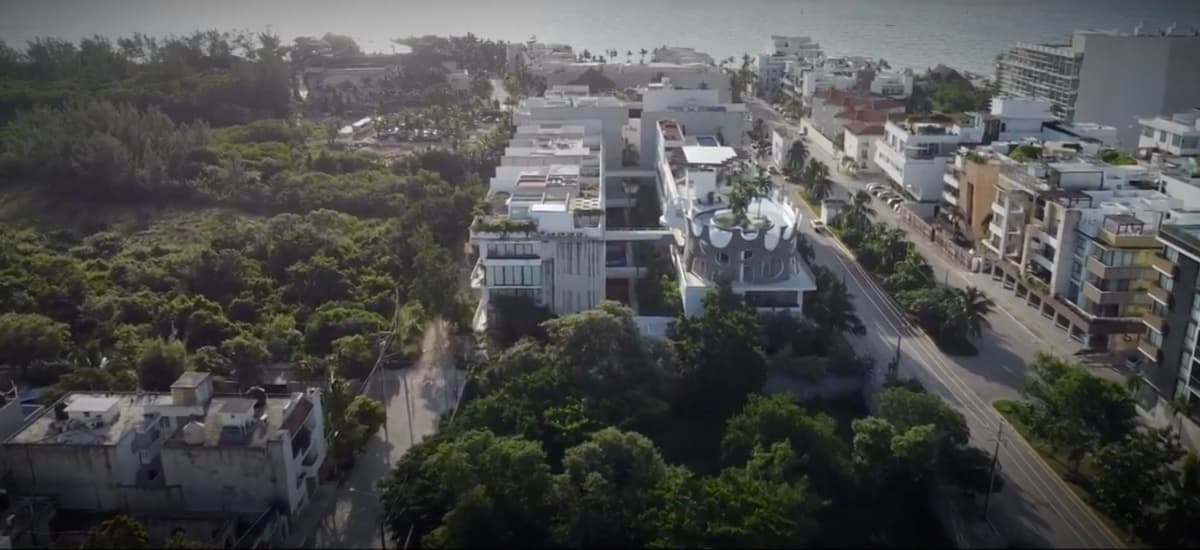
Before the hotels, before Quinta Avenida and before the Riviera Maya had a name, Playa del Carmen was a fishing village facing Cozumel. Its old center was on what is now Calle 6, according to the municipality's official history, and the boats crossing from the island brought the few visitors who arrived.
What changed around 1970 was the scale. Regular crossings to Cozumel turned the dock into a gateway with constant traffic. The commercial activity, the service offering and the life of downtown grew around the point where people arrived and departed.
More than fifty years later, the dock is still in the same place.
What the terminal said in 2004
The Environmental Impact Assessment that Navegación Veracruzana filed with Semarnat in early 2005 describes the terminal as it was at the time. According to that document, operations had begun about 35 years earlier with a wooden dock, placing the start around 1970, and a concrete dock had been operating for about 25 years. The dock measured 84 meters.
The same document records an average of 8,848 dock users per day in 2004, counting boardings and arrivals on the Cozumel crossing and on the boats serving cruise ships. This is not a tourist figure: it is an infrastructure figure. Thousands of people passing through the same point each day, in a town that had 100,383 inhabitants in the 2005 count, sustain commercial demand concentrated in a few blocks.
The expansions and what they confirm
In December 2016, Navegación Veracruzana (Navega) inaugurated the expansion of its terminal and dock. It was a private investment of 59 million pesos for the whole project, financed mostly with commercial bank credit, according to T21. In August 2024 the same company began a new expansion, with an estimated timeline of 12 months, according to La Pancarta de Quintana Roo.
Each private investment in port infrastructure says the same thing: the dock stays where it is. It's not an administrative decision revisable every six years; it's a fixed investment at a geographic point that has functioned as the maritime connection between Playa del Carmen and Cozumel for more than half a century.
For anyone evaluating a property downtown, that is a permanence data point. Trends change, operators change, hotel names change. The dock's position does not.
The passenger flow over time
Records from APIQROO, the port authority, document the Playa del Carmen-Cozumel route since 2000. Through 2014 the route moved between 2.2 and 2.9 million passengers a year, in both directions. From 2015 to 2017 it grew strongly to the series high: 4,575,269 passengers in 2017. 2018 stayed nearly level and 2019 dipped slightly.
In 2020, with the pandemic, the route fell to 1,612,630 passengers, the lowest point in the entire series. It recovered from 2021 to 2023, reaching 3,863,260. It dropped to 3,551,965 in 2024 and rose to 3,853,770 in 2025, still below 2023 and the 2017 high. From January to August 2026, accumulated traffic was 4.55% below the same period of 2025.
The annual variation matters for those renting short-term or running a business that depends on passing tourism. The long-term trend matters for those buying to stay or to rent long-term. The two readings are different and point to different horizons.
The operators on the route today
Three operators cross the route today: Ultramar, Winjet and Xcaret Xailing. The last began operating on April 1, 2024. Its entry expanded the route's offering without changing the dock's structure or the terminal's location.
The Molcas and the dock's hotels
For decades, the Molcas hotel stood by the dock, with 26 rooms, between the main square and the terminal. It opened in the 1970s and closed in 2015, according to Noticaribe. Given its location, it was a natural option for those arriving from Cozumel or waiting for the crossing.
Its history connects directly to the article about hotels in Playacar and Puerto Aventuras we published recently: what disappeared in Playa del Carmen was not the beachfront hotels in the planned developments, but the small hotels of downtown, the ones that didn't have the scale to survive the transformation of the first blocks into a higher-volume destination. The Molcas was part of that chapter.
What the dock tells those buying nearby
Distance to the dock is not the only factor that defines the value of a property downtown, but it is one of the factors that changes least: the dock has been in the same spot for more than fifty years. The pedestrian flow between the terminal and Quinta Avenida has sustained demand for commercial spaces, short-term rentals and services for decades.
A property in that corridor, between the dock and the first blocks of Quinta Avenida, receives traffic that doesn't depend on a single season or a single type of traveler. It depends on the route, which has been operating for more than fifty years and which every infrastructure investment confirms will continue.
What's worth reviewing before buying in that area:
How many blocks from the dock the property is and whether that stretch has consistent pedestrian traffic or only in high season. If the intended use is short-term rental, what regulations the municipality applies to that specific property. Whether the property faces Quinta Avenida or is on a parallel street, because demand can be very different between the two. And whether there are construction or corridor expansion projects that could affect access or flow in the coming years.
The dock has been in the same place for more than half a century. The question is not whether the flow will be there, but what the specific property does with that flow.
Sources: APIQROO, passenger statistics for the Playa del Carmen-Cozumel route, 2000 to August 2026; Semarnat, Environmental Impact Assessment by Navegación Veracruzana, file 23QR2005TD013, 2005; INEGI, 2005 Population and Housing Count; Municipality of Playa del Carmen, municipal history; T21, Playa del Carmen dock expansion, December 16, 2016; La Pancarta de Quintana Roo, August 15, 2024; Noticaribe, September 12, 2015 and April 1, 2024.
Reference Real Estate Team
📍 Playa del Carmen, Quintana Roo
referencerealestate.mx
Did you enjoy this analysis? Join our WhatsApp community for more content on the Riviera Maya real estate market.
Join