
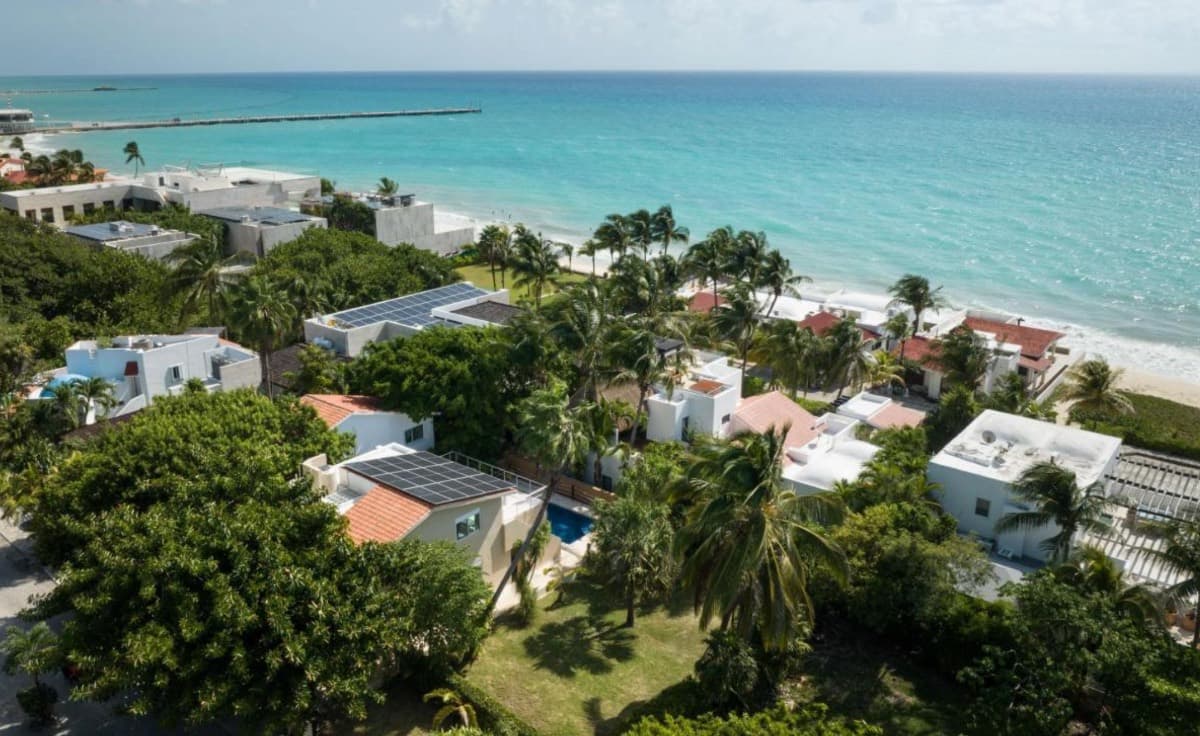
When someone asks me about Playacar, they almost always expect me to say it's the best place in Playa del Carmen to buy. My answer always starts the same way: it depends on what you're looking for.
Playacar is the most consolidated development in Playa del Carmen. That comes with very real advantages and some limitations that are equally worth knowing. This article covers both, because I believe a well-informed purchase decision starts exactly there.
An origin few people know
Playacar didn't start as we know it today. The land it sits on corresponds to the ancient Maya site of Xaman-Ha, meaning "water of the north" in the Maya language. It was a landing port and departure point for Maya pilgrimages to Cozumel to worship the goddess Ixchel. Three of the original eight building groups still stand inside the development, under INAH custody and free to access for residents and visitors.
Development began in 1979, when Fernando Barbachano (a pioneer of Caribbean Mexican tourism, from the same family that operated the first boat crossings from Playa del Carmen to Cozumel) started Phase 1 on 25 hectares. Phase 2 launched in 1984 across nearly 300 hectares. The project passed through the hands of American corporation Aircoa and reached Guadalajara's Grupo Sidek-Situr in 1994, just before the peso crisis. Sidek collapsed in February 1995 with a debt of 2.268 billion dollars. The hotels were sold off in pieces. The golf course, residential lots and infrastructure survived.
Forty-seven years later, Playacar is the residential community with the longest history on the Riviera Maya. That history isn't just anecdote. It's mature infrastructure, dense tree cover, an established community and a market that has been functioning for decades.
Legal certainty: what the numbers say
For anyone evaluating Playacar as an investment, there's a data point that rarely appears in sales materials and that at Reference we consider fundamental.
As of July 27, 2026, the official SEDETUS registry records 410 regular developments and 2 irregular ones in Playa del Carmen. An irregularity rate of 0.5%, the lowest in all of Quintana Roo. Isla Mujeres sits at 60.8%. Tulum at 3.8%.
| Municipality | Regular | Irregular | Rate |
|---|---|---|---|
| Isla Mujeres | 20 | 32 | 61.5% |
| Lázaro Cárdenas | 7 | 4 | 36.4% |
| Othón P. Blanco | 37 | 13 | 26.0% |
| Bacalar | 69 | 9 | 11.5% |
| Puerto Morelos | 70 | 6 | 7.9% |
| Tulum | 787 | 38 | 4.6% |
| Benito Juárez | 826 | 28 | 3.3% |
| Playa del Carmen | 410 | 4 | 1.0% |
| Statewide | 2,228 | 134 | 5.7% |
Left out of the breakdown for having fewer than 10 registered developments: José María Morelos, Felipe Carrillo Puerto. With bases that small, a single case moves the percentage by several points.
A municipality that appears in neither registry is not a municipality without developments: it is one these registries hold no entries for.
SEDETUS registries as of September 21, 2026. Source: SEDETUS Quintana Roo, Regular Developments Registry and Irregular Developments Registry.
Playacar is a development with decades of documentary history. Deeds are duly registered with the Public Property Registry. Foreign buyers operate through a bank trust, the standard legal instrument for the restricted zone. The condominium regime of each building or complex is registered. And the Xaman-Ha archaeological site has formal INAH custody, which clarifies the status of that area within the development.
That doesn't mean any property in Playacar is exempt from review. Each resale transaction requires its own verification of liens, clean title and current tax standing. But the legal ecosystem you're buying into is among the most consolidated in the region.
Security: what exists and what's worth knowing
Playacar is a gated community with controlled access. Three private security checkpoints regulate entrances and exits. That generates a sense of security that is one of the most cited factors by those who choose to live here, especially international families and second-home buyers.
The reality has nuances. In March 2014, local press documented a wave of large-scale burglaries in Playacar residences, with private security guards implicated as alleged accomplices in some cases. The incident made clear that controlled access is not an absolute guarantee.
At a broader level, the perception of insecurity in Playa del Carmen in 2024 affected the destination's reputation in general, according to Reportur and hotel industry press. The 2026 data shows significant improvement: intentional homicides fell 55% in the first half of the year compared to the same period in 2025. But perception, as always, takes longer to recover than the numbers.
For those coming to live in Playacar, controlled access and an established community remain a real advantage. For those buying to rent who will never sleep there, that factor weighs differently.
The beaches: the good and what you need to know
Playacar's beaches are internationally recognized for their white sand and turquoise waters. Phase 2 concentrates most of the beachfront hotels; Phase 1 has villas with direct beach access. The Xaman-Ha pier, at the northern end of the development, is the former Cozumel ferry crossing point and one of Playa del Carmen's most iconic sea access points.
There are two variables every buyer should know before idealizing Playacar's beaches.
The first is sargassum. Since 2015, the massive arrival of sargassum seaweed to Quintana Roo's coastline is a seasonal phenomenon that repeats every spring and summer, peaking between May and August. Playacar is not exempt. Citizen monitoring and local press have repeatedly identified the Xaman-Ha pier area and Playacar as zones with significant accumulation during peak season.
The second is coastal erosion. An environmental impact study documented that since 2004, more than 30 meters of coastal strip have been lost in the northern Playa del Carmen area, with accelerated deterioration since 2019. In September 2026, Zofemat identified the Xaman-Ha pier as one of the priority points for returning sargassum-recovered sand to the beach, pending Semarnat approval.
That said, Playacar's beaches outside of sargassum season remain among the best in Playa del Carmen. And Phase 2 has wide, calm beach with few people compared to the center, a combination many residents consider unbeatable.
The golf course
In 1994, while the rest of the Mexican Caribbean was barely beginning to develop, Playacar inaugurated the Riviera Maya's first championship golf course. It was designed by Robert von Hagge and Jeffrey Blume, with 18 holes, par 72 and 7,136 yards. For decades it was called the Playacar Spa and Golf Club. Today it operates as the Hard Rock Golf Club Riviera Maya.
It's considered the most challenging course in the region: narrow fairways, small greens and a layout carved through jungle. Current reviews are mixed regarding the service experience under the Hard Rock brand, but the course itself remains a regional reference.
For those buying in Playacar who play golf, proximity to the course is a real differentiator. For those who don't play, membership fees are optional and the course is a landscape amenity that gives the development its character.
The amenities inside the development
Playacar has something few residential developments on the Riviera Maya can offer: a complete service ecosystem within the same development.
The Xaman-Ha Aviary, open since 1993, houses flamingos, toucans, parrots and other species in a jungle setting inside the development. It's one of the most singular amenities of any residential community in the region.
There are two commercial plazas with restaurants, a supermarket, pharmacy, services and shops. A bilingual private school for those arriving with school-age children. The golf course. The Maya ruins. And a consolidated international community, with active groups of Canadian, American, European and Latin American expats who have been living here for years.
Access to the center: the most underrated advantage
Playacar has a geographical position that very few residential developments on the Riviera Maya can match: it sits right up against the south end of Playa del Carmen, with walkable access to Quinta Avenida and Quinta Alegría.
That means you can live in a quiet, gated community with beach, and be ten minutes walking from the best restaurants, cafés, shops, clinics and services in Playa del Carmen. No car, no traffic, no waiting for a ride.
For the buyer profile that values that combination, there's nowhere else in Playa del Carmen that has it. Playacar is the only large-scale gated residential community with walkable access to downtown.
What's available today
Playacar is a practically built-out development. There are no large new construction projects inside the development, which means the available supply is primarily resale: second-hand houses and apartments, with the infrastructure and tree cover that decades of development provide.
That relative scarcity of new supply is, paradoxically, one of the factors that sustains asset values in Playacar. There's no presale oversupply competing with what already exists.
The entry ticket is higher than in other areas of Playa del Carmen. Three-bedroom houses with garden and access to the development's amenities move between MXN $5.8 million and over MXN $15 million. Apartments range from more accessible prices in interior units to several hundred thousand dollars for beachfront product.
If you want to see what's currently available in Playacar, you can browse our zone-filtered catalog.
To close
Playacar isn't for everyone. The entry ticket is high, the beach has seasonal variables worth understanding and available supply is limited.
For those looking for the specific combination of an established community, solid legal certainty, walkable access to downtown Playa del Carmen and a complete service ecosystem within the same development, it's hard to find an equivalent on the Riviera Maya.
If you're evaluating Playacar and want to review the available options with us, we'd be glad to help.
Sources: Sistema de Información Cultural, Secretaría de Cultura; Noticaribe; Expansión; Por Esto!; GolfNow; Reportur; Heraldo de México Quintana Roo; SEDETUS regular and irregular developments registry, July 2026; Iberostar; Semarnat coastal erosion data 2026.
Nat Vázquez
Certified Real Estate Advisor · Reference Real Estate
📍 Playa del Carmen, Quintana Roo
📱 +52 (984) 195-0103
Did you enjoy this analysis? Join our WhatsApp community for more content on the Riviera Maya real estate market.
Join