
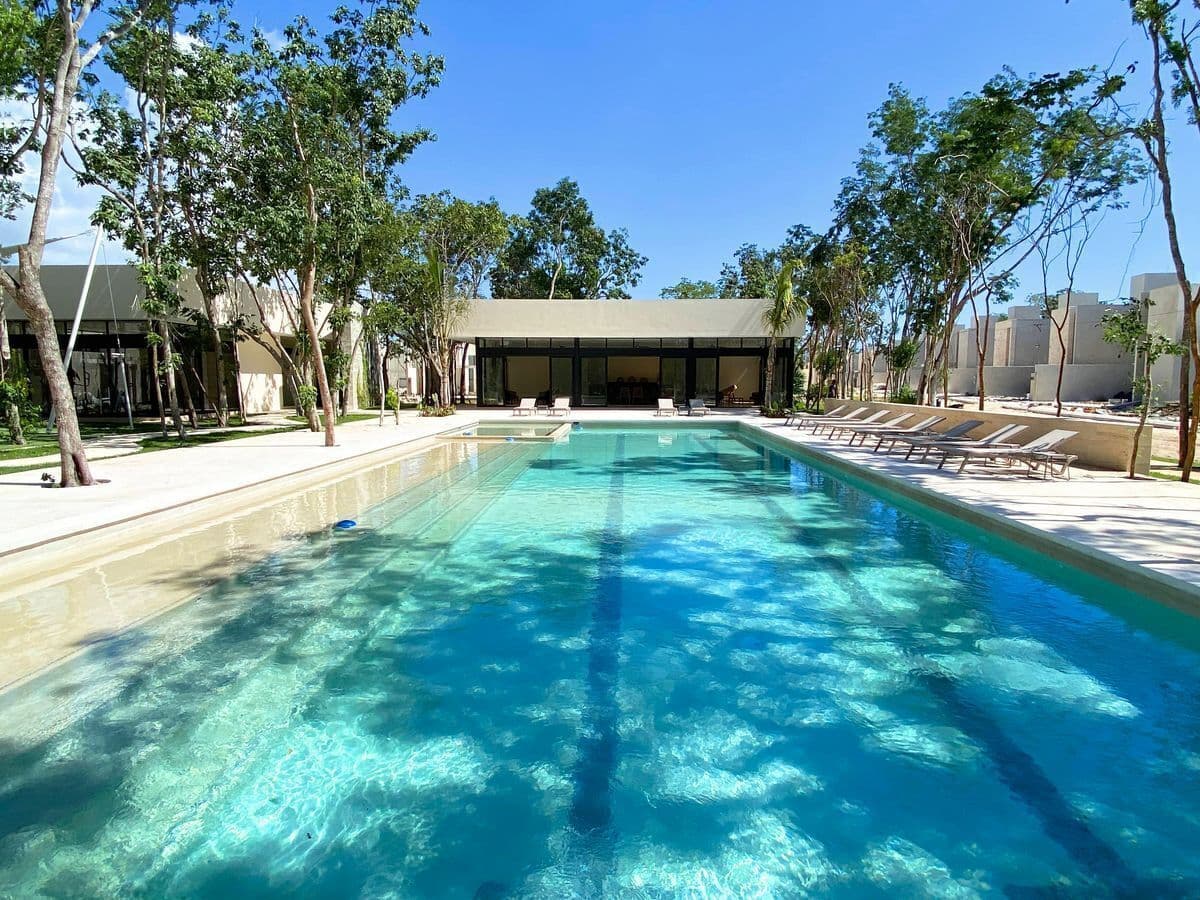
Every year more people arrive in Playa del Carmen with a question very different from the investor's or second-home buyer's. They don't ask how much the property will be worth in five years or what the average Airbnb occupancy is. They ask if they can live well here. If there are good doctors. If you can get around without a car. If they'll find community.
These are the questions of someone who's coming to stay.
The retiree profile on the Riviera Maya has grown steadily. INEGI registered 39,586 people born abroad in Quintana Roo in the 2020 Census, and press estimates place between 15,000 and 25,000 foreign residents in Playa del Carmen alone by 2026. The main countries of origin are the United States and Canada, followed by Argentina, Colombia, Spain and Italy.
For all of them, the questions that matter are different from the typical buyer's. And so are the answers.
The real cost of living
One of the most frequent reasons retirees choose the Riviera Maya is economic. The purchasing power of a US or Canadian pension in Mexican pesos allows a standard of living that would be difficult to sustain in their home countries.
According to Numbeo data updated to 2026, a single person can live comfortably in Playa del Carmen on between USD$2,500 and USD$3,600 per month. A retired couple with a comfortable lifestyle, including international health insurance, air conditioning in summer and occasional flights home, budgets between USD$3,000 and USD$4,500 per month.
The breakdown by category paints a clearer picture. Renting a one-bedroom apartment in the center runs around USD$1,090 per month; outside the center you can find options from USD$400. Basic utilities for an 85m² apartment add up to about USD$90 per month, though air conditioning in summer can significantly raise the CFE bill. A 60 Mbps internet connection costs approximately USD$31 per month.
The comparison with home cities is revealing. The cost of living in Playa del Carmen is approximately 40 to 50% lower than in San Diego. Toronto and Vancouver are among the most expensive cities in North America, far above what it costs to live well here. Madrid is cheaper than Toronto but still more expensive than Playa del Carmen in most categories.
One thing worth being clear about: housing in expat areas like the center, Playacar and Gonzalo Guerrero is priced at tourist market rates, not local Mexican market rates. It represents between 35% and 45% of the monthly budget. It is not the "cheap Mexico" of 1990s brochures, but it is still significantly more accessible than the cities most international retirees come from.
Cost of living comparison
City | Relation to Playa del Carmen |
|---|---|
San Diego, USA | ~40-50% more expensive |
Toronto, Canada | Well above, among the most expensive in North America |
Vancouver, Canada | Comparable to Toronto, well above PDC |
Miami, USA | Well above PDC |
Madrid, Spain | Cheaper than Toronto but more expensive than PDC in most categories |
Mexico City | PDC is ~8% more expensive, among Mexico's priciest cities |
Source: Numbeo and Expatistan, June 2026. Comparisons are indicative.
Healthcare: what you need to know before coming
Healthcare is the variable that most frequently determines whether a retiree stays or leaves. Playa del Carmen has a private medical infrastructure that has improved significantly in recent years.
The main private hospitals in Playa del Carmen are four. Hospiten Riviera Maya is considered the most complete: part of the international Hospiten group, it has 24-hour emergency care, surgery, imaging and ICU, with ISO certifications and multilingual staff. Costamed offers a broad range of services including dental care, with English-speaking staff. Hospital Joya covers cardiology, bariatric surgery and other specialties, also with English-speaking staff. Amerimed is oriented primarily toward tourists and travel insurance.
For high-specialty care, many expats go to Cancún or to Star Médica in Mérida for complex cases.
Prices are significantly lower than in the United States or Canada. A private general practitioner consultation costs between MXN$600 and MXN$1,500; a specialist between MXN$1,200 and MXN$3,000. Cataract surgery costs approximately USD$2,100 per eye, compared to USD$3,500 in the United States.
For health insurance, there are three main options. Voluntary IMSS costs between USD$89 and USD$93 per month for people aged 60 to 79, though it excludes pre-existing conditions with waiting periods. Private Mexican insurers like GNP, MetLife or AXA run USD$150 to USD$300 per month with access to private hospitals, but have limited coverage outside Mexico. International insurers like Cigna, Allianz, Bupa or VUMI run USD$300 to USD$700 per month and cover care both in Mexico and in the home country.
One important note: many Mexican insurers restrict new policies for people over 60 to 70 years old. It is worth securing coverage before reaching those thresholds.
Visas and residency: the updated 2026 process
Mexico has two main options for those who want to live here permanently, and there was an important change in 2025 worth knowing about.
In July 2025 a DOF decree ordered consulates to calculate financial solvency using the UMA rather than the minimum wage. This prevented the threshold from jumping significantly and kept it at more accessible levels for 2026.
The Temporary Resident Visa requires demonstrating monthly income of approximately USD$4,400 or savings of around USD$74,000. It is valid for one to four years, renewed annually. After four years as a temporary resident you can apply for permanent residency.
The Permanent Resident Visa requires income of approximately USD$7,400 per month or savings of around USD$300,000. It has no expiration date and gives access to most rights of a Mexican citizen, except voting.
The process must be initiated at the Mexican consulate in your home country before traveling. It cannot be started while in Mexico as a tourist. The steps are:
Verify the updated requirements at the Mexican consulate in your country, as amounts are quoted in local currency and may vary between consulates.
Prepare six months of bank statements demonstrating the required income, or twelve months if using the savings route.
Schedule an appointment at the consulate and submit documentation. Approval time is one to four weeks.
Upon arriving in Mexico, exchange the visa for the resident card at INM within 30 days. The INM office in Playa del Carmen is at Av. Constituyentes corner Av. 95, Monday to Friday 9:00 AM to 1:00 PM.
The consular visa costs approximately USD$56. The one-year INM card costs MXN$11,141.
Which areas work best for retirees
Not all areas of the Riviera Maya have the same profile for a retiree. The choice of area depends heavily on the lifestyle being sought.
Playacar is the most popular option among international retirees, especially North Americans and Canadians. A private community with controlled access, golf course, beach and walkable access to Playa del Carmen. There is an established expat community that greatly eases integration. Property prices are among the highest in the area, with houses ranging from MXN$5.8 million to over MXN$15 million. Typical maintenance fees run MXN$6,500 per month for an apartment and MXN$12,500 for a house. A car is recommended for comfortable mobility.
Downtown Playa del Carmen, especially Gonzalo Guerrero and Hollywood, attracts the more urban retiree. Someone who wants to walk to restaurants, the market, the beach, without depending on a car. It is more cosmopolitan, more diverse and generally more accessible in price than Playacar. A one-bedroom rental runs USD$500 to USD$1,650 per month.
Puerto Morelos is a growing option for those seeking tranquility without straying too far from Cancún or Playa del Carmen services. Smaller, quieter, with a growing expat community and prices still below the Riviera Maya average. A car is practically required.
Puerto Aventuras has a well-established retiree community, especially among those who enjoy the nautical lifestyle. Private marina, golf course, international school within the development. A car is practically required.
Community: the factor that matters most
After nine years living in Playa del Carmen, what I hear most from retirees who are happy here isn't about the weather or the cost of living. It is about the community they found.
Playa del Carmen has active expat groups on virtually every platform: Mexpats Club, Expats and Locals in Playa del Carmen, Ladies of Playa, Friendly Expats in Playa del Carmen. InterNations organizes regular networking events. Nomads Giving Back combines social projects with networking.
For those who want to engage more actively with the local community, there are volunteer organizations like Coco's Animal Welfare, Moce Yax Cuxtal on environmental issues and The KKIS Project in education.
The retirees who integrate best are those who arrive willing to participate, to learn some basic Spanish and to engage with both the expat community and the local one. Spanish is essential for paperwork, doctors and daily life. In tourist areas you can get by with English, but those who have been here for years acknowledge that without Spanish the experience is more limited.
Variables worth knowing about
There are three factors worth understanding before deciding, because they affect daily quality of life in real ways.
Sargassum is a seasonal variable that shouldn't be ignored. The season runs from May to October, peaking in June and August. The University of South Florida's Optical Oceanography Lab projects 2026 as a likely record year. It doesn't affect all areas equally, some beaches manage it better than others, but it is a reality of the Mexican Caribbean that is part of the context of living here.
CFE power outages are recurring during the hot season, especially in the warmest months. There are documented reports of merchant protests and appliance damage in Playa del Carmen. A UPS or backup generator is an investment many retirees end up making.
Tap water is not drinkable. Bottled water or a garrafón delivery service is the standard. According to Centinelas del Agua, Playa del Carmen has groundwater quality indices below the Caribbean Mexican average.
That said, on security the picture has improved in measurable ways. Quintana Roo registered a 57% reduction in intentional homicide victims between 2024 and 2025, from 676 to 291, the third largest national decline according to SESNSP. In Playa del Carmen, intentional homicide went from 28 cases between January and July 2025 to 15 in the same period of 2026, a 46.4% drop; vehicle theft fell 45.1% and home burglary 37% against that same period. These figures come from the Playa del Carmen city government bulletin of August 27, 2026, with data from the Executive Secretariat of the National Public Security System. Petty crime like pickpocketing and phone theft persists in busy tourist areas, as in any destination of this type.
How we work with retirees at Reference
When we work with a retiree, the questions we ask are different from those we ask an investor.
We ask about mobility and accessibility. About proximity to healthcare services. About the type of community they are looking for. About whether they will drive or prefer a walkable area. About whether they have family who will visit and need extra space.
And we ask about the horizon. Buying for the next five years is different from buying for the next twenty. That difference changes which type of property, in which area and with which characteristics makes the most sense.
Before looking at any property, we verify the advisor is registered in the SEDETUS registry and that the development doesn't appear on the list of irregular ones. It is the same standard we apply for any client, and for a retiree who is going to build their life here, that certainty is especially important.
If you're evaluating the Riviera Maya as a retirement destination and want to have that conversation with us before making any decisions, we'd love to have it.
Sources: INEGI 2020 Census, Numbeo June 2026, Expatistan May 2026, SESNSP via Noticaribe December 2025, Playa del Carmen city government bulletin of August 27, 2026 with data from SESNSP, University of South Florida Optical Oceanography Lab May 2026, Centinelas del Agua 2026, INM Migration Rights Fees 2026, Mexperience 2026, Pacific Prime 2026, Hospiten.com, Costamed.com.mx.
Nat Vázquez
Certified Real Estate Advisor · Reference Real Estate
📍 Playa del Carmen, Quintana Roo
📱 +52 (984) 195-0103
Did you enjoy this analysis? Join our WhatsApp community for more content on the Riviera Maya real estate market.
Join