
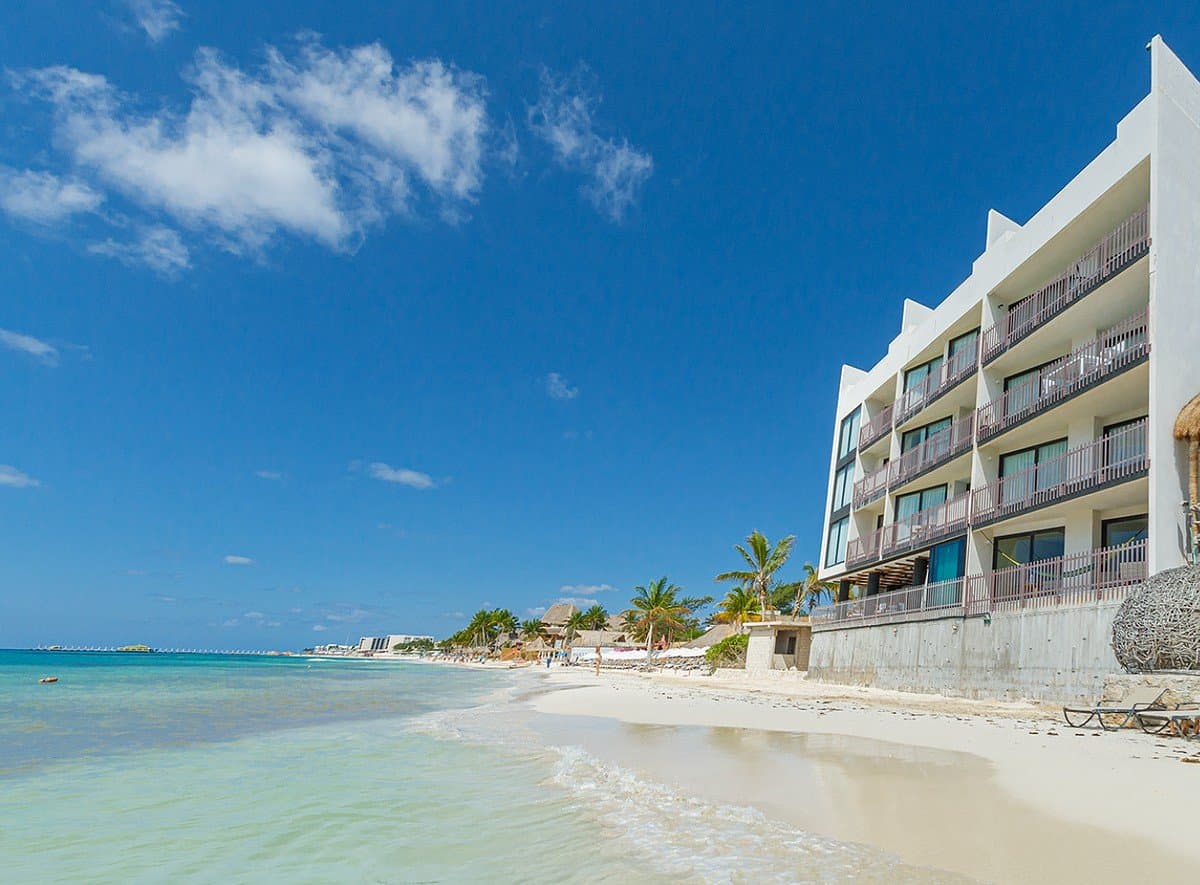
If you are considering buying in Playa del Carmen, there is one line you are going to hear. It may come from someone you know, from a video, from a comment on a forum:
"Playa isn't what it used to be. You got here too late."
It is probably true. It is also probable that whoever tells you arrived at a moment when someone else was telling them exactly the same thing.
We got curious about how far back that line goes, so we went to look.
What we did
The trail starts in the nineties, not in the year 2000: Usenet groups, Wayback Machine captures from 1996 and printed travel guides from the period. From there on come travel forums, reviews, travel press and Reddit threads, in English and in Spanish, through 2026.
We did not measure expert opinion or destination press releases. We measured what people wrote on their own, with a date on it, coming back from a trip or deciding to move.
This is our own exercise, not an academic study. At the end of the article we say what it cannot see.
What we found
The nostalgia does not show up at some point. It is there from the beginning.
Before the ladder of dates it is worth fixing the baseline, because it changes how everything that follows reads. Playacar starts around 1991. The population goes from some 17 thousand residents in 1995 to 44 thousand in 2000. By the time the first digital record of the town exists, Playa had already more than doubled, and the change everyone would later mourn had been running for almost a decade. What follows, then, is not the chronicle of a transformation: it is what was said after it.
In the year 2000, already with those 44 thousand residents, the travel press was describing the fishing village in the past tense. Not as something happening, but as something that had happened recently.
In 2005, a traveler wrote on a forum that the place was still small enough for the real Mexico to exist there. He said it the way you say something is about to end.
In 2008 someone posted on Tripadvisor that it was no longer the sleepy fishing village it had been.
In 2015 sargassum, overcrowding and prices appear. In 2017, safety. In 2021, digital nomads and Airbnb. In 2024, "it is not what it was". In 2026, gentrification and the cost of living.
Twenty five years, the same sentence, a different reference point every time.
The pattern
Laid out in order, this is how the conversation about Playa looks by decade:
2000. Quiet, smaller than Cancún, cheap. The appeal is defined by contrast: it is not Cancún.
2008. Walkable, with restaurants and bars, boutique. No longer a secret.
2012. Commercial, a city, condos, a crowded Quinta Avenida. And even so, "it still has charm".
2017. Safety in question, sargassum, expensive. People ask whether paradise was lost.
2021. Digital nomads, coworking, wifi, a community passing through.
2026. Gentrification, prices, sargassum, the Maya Train, and a city that official marketing now presents as a food destination.
Every slice has its criticisms and all of them are real. What none of them has is an earlier moment when people were happy with how things were going.
Why this happens
There is a simple explanation and it is the one that convinced us most.
The internet did not document the disappearance of an untouched village. It arrived late, when the transformation was already underway, and that is the underlying reason. The figures above say it without adjectives: by the time the first travelers began writing about Playa on forums, the change had been running for almost a decade.
So what got recorded was not the village. It was the mourning for the village, written by people who mostly never knew it.
The fishing village existed, that is documented. What the evidence calls into question is whether it was as sleepy as it was later decided to remember it.
The nostalgia moves
The second finding is more useful for anyone choosing where to buy.
The "authentic" place never stays put on the coast.
At first Cancún was what you had to avoid and Playa was the alternative. Then Playa grew and those qualities moved to Puerto Morelos, to Akumal and above all to Tulum. Around 2020 Tulum started being described as expensive and overrated, and Playa recovered value, no longer as an authentic destination but as a functional base: the one with services, hospitals, schools and connectivity.
That cycle has repeated three times in twenty five years.
Chasing the next authentic place is a strategy that sounds good and works badly, because the title moves every six or eight years. Buying where the infrastructure is, on the other hand, ages differently.
What did change, and is not opinion
We do not want to leave the impression that every criticism is nostalgia. Several are verifiable facts.
Prices really did go up. Cost of living stopped being an argument in favor more than a decade ago, and today it is one of the most frequent complaints.
Sargassum is real and seasonal, with some seasons worse than others, and the beach erosion argument was added to it recently.
The city is bigger, denser and more expensive than it was twenty years ago. None of that is in dispute.
What we are saying is not that the criticism is false. It is that the criticism has been continuous, and that anyone using it to conclude "it is not worth it anymore" is using the same argument someone used in 2005 to decide not to buy at a fraction of today's price.
And what improved
There are also things that show up in the recent record and did not exist before.
Playa today is a walkable city with a serious food scene, an established international community, accessible healthcare and connectivity it did not have. The Maya Train began passenger service on the Cancún to Playa del Carmen stretch in March 2024.
And there is one detail we liked: in 2025 the municipality took back the name Playa del Carmen, after three decades of being called Solidaridad. In all the vocabulary we reviewed, it is the only word that came back from the past.
That name change is not purely symbolic either. The municipal revenue statute is still findable online under the old name, and anyone searching that way can end up reading a rate that has already changed. We went through it when we compared the property acquisition tax across the eleven municipalities of Quintana Roo.
What to do with this if you are buying
Three things.
The line "you got here too late" is not information. It is a literary genre with twenty five years of history. Ask whoever says it when they arrived, and you will see the pattern.
Do not chase the next authentic place. The title moves. The infrastructure does not.
And separate verifiable criticism from nostalgia. Prices, sargassum and density are data you can check. "It is not the same anymore" is an impression that depends entirely on when the person saying it arrived.
What this exercise cannot see
For the sake of honesty, the limits.
The corpus is almost entirely anglophone until around 2012, and skews tourist, diver or nomad. The voice of Mexican residents enters late and mostly through the press, so this record describes how visitors talked about Playa, not how the people who live here experienced it.
Several sources were lost. A residents forum that ran from 2000 to 2018 disappeared entirely.
The nineties corpus is much thinner than the rest: about twenty Usenet threads and fragmentary captures, against thousands of dated messages from 2005 onward. The years 1990 to 1994 are practically empty. So the baseline for that decade rests on population figures and documents, not on the volume of testimony: of what people were saying in 1995 we have indications, not a sample.
And there is a complaint bias: someone who returns after ten years and is disappointed writes more than someone who arrives and is delighted.
None of that invalidates the pattern, which is consistent across twenty five years and across different sources. But it is worth saying.
This analysis is an exercise of our own at Reference Real Estate over dated public content. It is not an academic study and does not claim to be. We publish it because whether you got here too late is the question we are asked most, and it seemed to us to deserve an answer with evidence instead of an opinion.
Did you enjoy this analysis? Join our WhatsApp community for more content on the Riviera Maya real estate market.
Join